Cornwall, England
The Lighthouse (Alison Moore Edition)Cornwall, England, is more than the setting of a family holiday in Futh’s past: it is where a summer picnic, a broken silver perfume vial, and the knowledge that his mother is leaving become fused in memory. Its cliffs hold the lighthouse that his father describes as a warning against wreckage, even as the family’s own rupture takes shape beside it. Long afterward, the scent spilled there continues to carry Futh back to the holiday and its aftermath.
Setting and the Family Holiday
The holiday takes place during the heatwave summer between primary and secondary school. Futh’s parents spend a week in a caravan, where the advice is to keep the windows closed and the blinds down so the interior will not turn into an oven. At midday, the family returns from the blazing outdoors to the relative cool of the darkened caravan; lunch and a siesta interrupt the day before Futh can escape outside again. The holiday’s weather is not simply a backdrop: the intense sun, the caravan’s enforced shade, and the cliffs’ breeze shape the ordinary rhythms around the pivotal picnic.
On the cliffs, the breeze makes the heat deceptive: despite the extraordinary temperatures, a person can burn unexpectedly. Futh’s mother has made sandwiches, and he and his father share a savoury pasty from a paper bag. His father opens a bottle of Pomagne, which no one else wants; oranges are present, but only his mother eats one. Afterward, she lies back on the grass with her eyes closed. The port-wine stain beneath her bikini strap is visible, and she smells of sun cream. These small details—food, exposed skin, and the mother resting beside the family—give the scene a calm domestic surface that contrasts with what is about to happen.
The Lighthouse and the Broken Vial
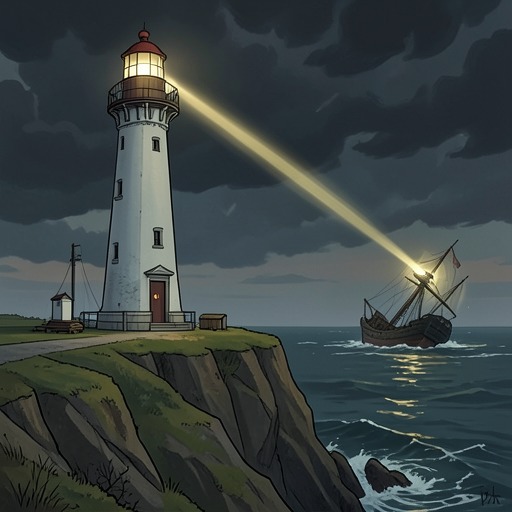
The lighthouse dominates the father’s talk on the cliffs. He explains its flashing pattern and the use of a foghorn, and recounts the wreckers who plundered stranded ships. The warning system does not end the danger: Futh wonders how wreckage can persist despite the lighthouse’s constant signals and precautions. His father’s account includes bodies washed ashore and buried without names in unconsecrated dunes. The landscape thus comes to Futh already layered with stories of people lost, warnings given, and damage that warnings cannot prevent.
The silver lighthouse perfume case has arrived through the family’s visit to Futh’s grandfather. His grandfather gives it to Futh’s father and tells him it belonged to his mother and should be returned to Ernst. Outside the house, Futh’s father passes it to Futh’s mother; she admires the case and the vial, approves of the scent, and applies it to her wrists and throat. The car fills with the smell of violets. On the cliffs, Futh carries the silver case and the stoppered glass vial back toward his parents while his mother lies with her face turned to the sun and his father looks out to sea.
The moment turns when Futh’s mother tells his father how much he bores her. His father quietly packs the picnic, closing the cool-box and gathering the food, while Futh watches gulls fight over the remains. Looking down, Futh sees that the vial has broken in his palm. The glass has cut the fleshy pad beneath his thumb; perfume soaks into the wound, stings, runs between his fingers, and wets his boots. The scent rises from him as he stands among his parents and the remnants of lunch. The lighthouse case, initially an inherited object passed between family members, is now physically bound to Futh’s injury and to the scene of his parents’ estrangement.
The Journey Home and the Departure
The holiday ends with the family collecting their luggage and taking the train home from Cornwall that same afternoon. Futh’s mother changes from her sun clothes into travelling clothes in the toilets, putting on heeled shoes and then slipping them off again when she sits. The broken vial remains in the perfume case in Futh’s pocket. His hands have not been washed, and both they and his boots smell strongly of violets; his mother instead smells of the orange she ate before falling asleep against the dirty train window. His father goes to the buffet car and stays away until they are nearly home.
On the rushing train, Futh understands that his mother is leaving. He wants the journey to slow and the train not to stop, imagining that if his mother stays asleep and his father remains in the bar, the arrival can be postponed. But the train continues through the darkening evening; the names of stations pass outside, his father returns and wakes his mother, and the train reaches its stop. The next morning, the kitchen smells of coffee. Futh recognizes the pink summer dress his mother wears from his parents’ honeymoon photographs as her going-away dress, and sees the brightly coloured suitcase she had kept packed beneath the bed. She kisses him, takes the suitcase, and leaves while his father is still upstairs. In the suddenly empty kitchen, Futh picks up her cup and finds it still warm.
A Place Recalled Through Scent
The perfume’s violets persist as a sensory trace of the Cornwall holiday and the departure that followed it. For a long time, Futh lifts his palm to his nose in search of the scent. Years later, when he works in the manufacture of artificial odours, octyl acetate makes him sad, linking a professional encounter with manufactured smell to the remembered holiday. His mother’s perfume is only one part of the sensory record: the orange she eats on the train, the sun cream on her skin, and the smell of her wardrobe—leather, cigarette smoke, and camphor from summer mothballs—belong to the same web of association. As a child, Futh makes a nest in that wardrobe and imagines bottling its particular atmosphere as an “Essence of Mother”; what he actually retains most powerfully from Cornwall is violets and oranges.
The memory also returns through his adult journey. A meat pie given to him by Carl’s mother recalls a Cornwall picnic: beef and onion pastry in a greasy paper bag, eaten on a cliff in blazing sun while his father talks about the lighthouse and a notorious wrecker. Elsewhere, a bottle’s smell of camphor pulls him back to the dark wardrobe, showing how closely the holiday’s remembered scents sit beside other memories of his mother. On an aeroplane journey with Angela, Futh dreams that his mother has sent a letter with a new name and address, but he cannot read her handwriting. The dream gives a later form to the absence first made concrete by the departure: he longs for a way to find her, yet the means of contact remains illegible.
Narrative Significance
Cornwall concentrates several recurring patterns in Futh’s life into one formative episode. His father’s lighthouse story insists on the difference between warning and rescue: a beacon can flash and a foghorn sound, yet ships still wreck. In the holiday’s parallel family drama, Futh senses that his mother is leaving but cannot stop the return journey or make the warning alter what happens. The broken glass makes that helplessness bodily, cutting his hand as the perfume that signifies his mother enters the wound.
The place also becomes a hinge in the novel’s movement between present experience and remembered childhood. Food, weather, an object, and above all scent return Futh to the cliffs, then carry him onward to the train and the empty kitchen. Cornwall matters not because the family’s stay resolves anything, but because the holiday’s bright, ordinary details remain inseparable from the departure they precede. The lighthouse promises guidance across distance; Futh’s memory preserves instead the warning, the wreckage, and a mother’s scent that cannot lead him back to her.